


What is a Shop/Office?
Traditional prewar double-storey terraced shophouses were originally developed to combine commercial and residential functions. Traders could operate their businesses on the ground floor while the upper floor served as the family residence. Many examples of these traditional shophouses can still be found in the older parts of Malaysian towns and city centres.
Following independence, Malaysia experienced rapid urbanisation, economic growth and expansion of its townships. The traditional shophouse gradually evolved, with the upper floors increasingly being used for additional retail space, offices, storage and other commercial purposes.
This evolution gave rise to what we commonly refer to today as shop/offices properties.
Shop/offices have become an important component of Malaysia’s commercial property market. They accommodate a wide range of businesses, including food and beverage outlets, groceries, retail shops, workshops, repair services, professional practices and other service businesses.
Their popularity is often attributed to their accessibility and convenience, particularly where customers can park close to the property. Depending on location, size, tenure, configuration and market demand, individual shop/offices, particularly double-storey to four-storey shop/offices can command values of several million Ringgit.
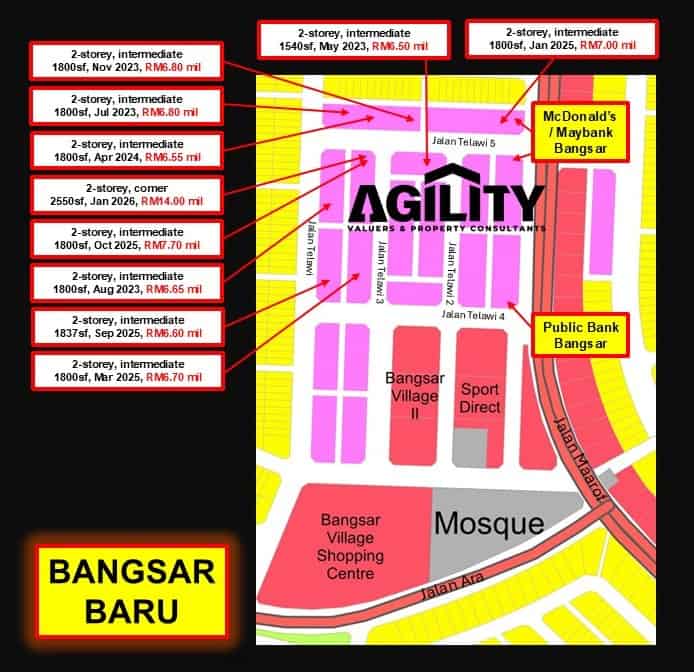
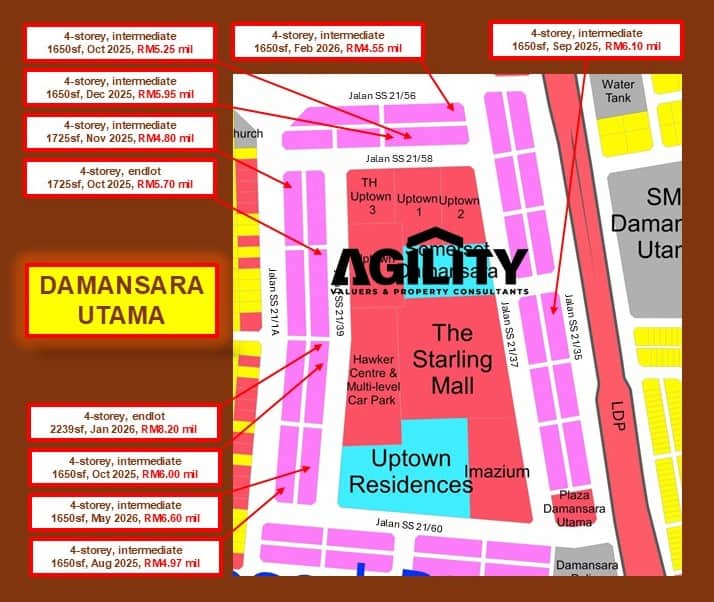
Agility Valuers & Property Consultants would like to share below some recent transactions of selected shop/office schemes to illustrate the range of values achieved in different locations.
Bangsar Baru
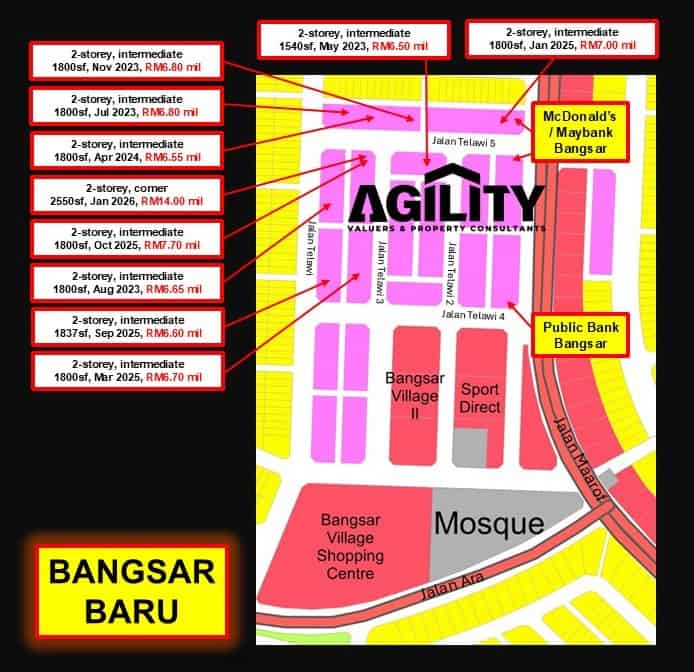
Bandar Baru Sri Petaling
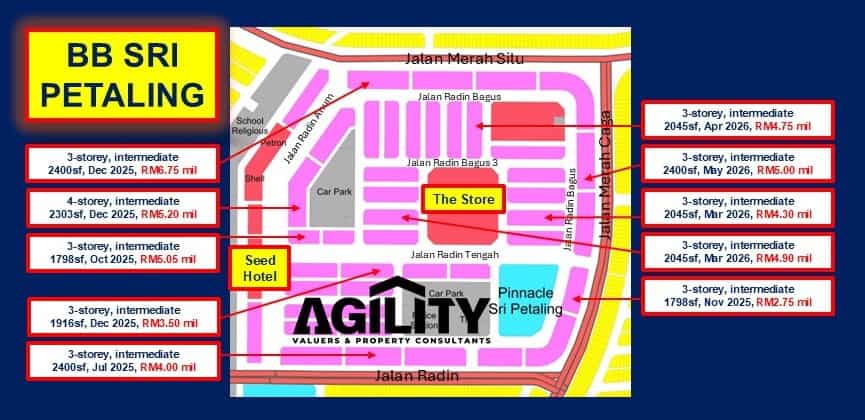
Kuchai Entrepreneurs Park
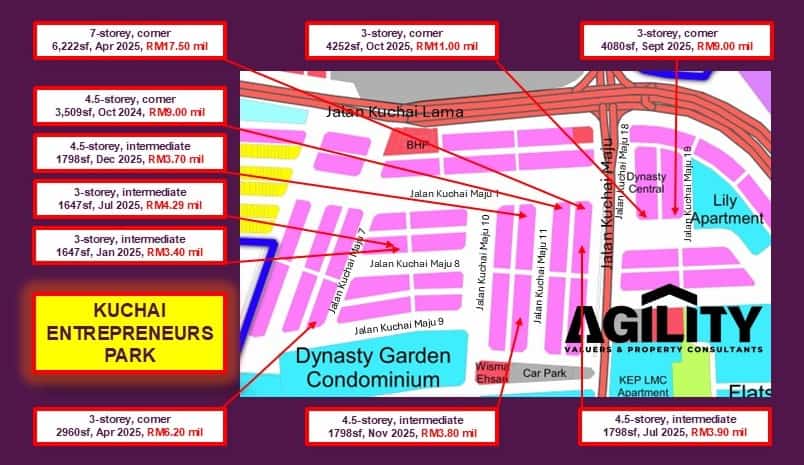
Damansara Utama
Why is a Shop/Office Valuation Important?
A professional property valuation may be required for a variety of purposes, including:
Sale and purchase
Bank financing and mortgage purposes
Investment decision-making
Estate distribution and inheritance
Taxation
Insurance
Financial reporting and accounting
Asset management and portfolio review
Other statutory or commercial purposes
A reliable valuation provides an independent professional opinion of the property’s value as at a specified valuation date and for a defined purpose.
What Determines the Value of a Shop/Office?
As with other types of property, the value of a shop/office is influenced by a combination of property specific, locational and market factors.
Key factors include location, accessibility and visibility, tenure and title condition, age and condition of building, parking availability, rental income, occupancy and tenancy, surrounding development and catchment, as well as market demand and supply.
The relative importance of these factors can vary depending on the location and characteristics of the property.
How is a Shop/Office Valued?
The principal valuation approaches commonly adopted by a registered valuer for shop/office properties are the Comparison Method and Investment Method.
The Comparison Method entails comparing the subject property with similar properties that have been sold recently and those that are currently being offered for sale in the vicinity or other comparable localities. The characteristics, merits and demerits of these properties are noted and appropriate adjustments thereof are then made to arrive at the value of the subject property.
In the Investment Method, the annual rental income currently received or expected for the lease of the subject property is estimated and deducted therefrom are the expenses or outgoings incidental to the ownership of the property to obtain the net annual (rental) income. This net annual income is then capitalised by an appropriate capitalisation rate or years purchase to arrive at the present capital value of the subject property. The capitalisation rate chosen is based on comparisons with returns on similar properties as well as the investment rates of return to be expected for similar properties taking into consideration such factors as risk, security of income, ease of sale, management of the subject property as well as overall economic factors.
Will Rental Income Affect the Market Value of a Shop/Office?
Yes.
For an income-producing shop/office, rental income can have a significant bearing on its market value, particularly when the Investment Method is applicable.
However, it is important to distinguish between the contractual passing rent and the market rental.
Where the existing tenancy is considered legitimate, enforceable and reflective of market conditions, the contractual rent may be an important consideration in the valuation. Where the passing rent differs materially from the prevailing market rental, the valuer will need to consider the terms of the tenancy, remaining tenure, rental review provisions and other relevant factors before determining the appropriate rental input for the valuation.
Therefore, a higher rental does not automatically mean a higher market value. Sustainability, quality and market support for the rental income are equally important.
For a further discussion, please refer to our earlier insight: “Does Tenancy Affect Property Value?”. Click : https://www.agilitymy.com/insight-en/does-tenancy-affect-property-value/
What Information Does a Valuer Need?
To carry out a proper valuation, a registered valuer will generally require relevant information and supporting documents, which may include:
Title deed / title particulars
Approved building plans and layout plans
Details of the property and improvements
Tenancy agreement and tenancy details
Current rental and rental history
Market rental evidence
Assessment notice
Quit rent information, where relevant
Recent transactions of comparable properties
Planning and land-use information
Other documents relevant to the valuation assignment
The information required may vary depending on the purpose, scope and nature of the property.
Who Can Carry Out the Valuation?
Valuation practice in Malaysia is regulated under the Valuers, Appraisers, Estate Agents and Property Managers Act 1981 (Act 242).
A professional valuation for purposes falling within the regulated practice of valuation should be undertaken by registered valuers or other person authorised under the Act.
The regulatory body is the Board of Valuers, Appraisers, Estate Agents and Property Managers (BOVAEP/LPEPH).
It is important to distinguish a professional valuation from an informal opinion of price or an asking price provided for marketing purposes.
What Does a Valuation Report Tell You?
A valuation report is a formal written document in which the signing valuer or valuation firm provides a professional opinion of the market value of a specific property within the scope of the assignment. Such reports must comply with the requirements of Malaysian Valuation Standards (MVS), in particular MVS 8.
A ordinary valuation report will usually contains Executive Summary, Terms of Engagement, Subject Property, Purpose of Valuation, Date of Inspection, Date of Valuation, Definition of Market Value / Forced Sale Value / Fire Insurance Value (if applicable), Title Particulars, Location, Description of the Subject Property, Occupancy, Services, Assessment, Planning Control, Method of Valuation, Evidences of Value, Opinion of Value, and Appendices / Exhibits / Annexures (where applicable).
Ultimately, a valuation report is more than simply a statement of “how much the property is worth.”
Frequently Asked Questions (FAQs)
A shop/office is a commercial property typically comprising retail or business space on the ground floor, with the upper floors used for offices, retail, storage or other permitted commercial purposes.
A valuation provides an independent professional opinion of the property’s value. It may be required for purposes such as sale and purchase, bank financing, investment, estate distribution, taxation, insurance or financial reporting.
The value is influenced by factors such as location, accessibility, visibility, tenure, size, building condition, parking, rental income, occupancy, surrounding development, and market demand and supply.
Yes. Rental income can have a significant impact on value, particularly for an income-producing property. However, the valuer will also consider whether the rental is sustainable and supported by prevailing market rental levels, as well as the terms of the tenancy.
Professional valuation practice in Malaysia is regulated under the Valuers, Appraisers, Estate Agents and Property Managers Act 1981 (Act 242). A professional valuation should be undertaken by an appropriately registered valuer or other person authorised under the Act.
———————————————————————————————————————————————————————
This blog / insight is based on Agility Valuers & Property Consultants / Agility Research (AVPC)’s current understanding and insights about the related topic in the current property / real estate market context. Agility Valuers & Property Consultants / Agility Research (AVPC) makes no guarantees, representation or warranties of any kind, expressed or implied, regarding the information including but not limited to, warranties of content, accuracy and reliability. Interested parties should undertake their own inquiries as to the accuracy of the information. Agility Valuers & Property Consultants Sdn. Bhd. / Agility Research (AVPC) excludes unequivocally all inferred or implied terms, conditions and warranties arising out of this document and excludes all liability for loss or damages arising therefrom.
Neither the whole nor any part of our blog or insights may be included in any published document, circular, prospectus or statement, nor published in any way without the prior written approval of Agility Valuers & Property Consultants Sdn. Bhd. / Agility Research (AVPC). We shall not be obligated to update this blog / insight in response to changes in market conditions or the regulatory environment subsequently.
For more information, please contact:
Sr Yap Kian Ann
Tel: 603-9544 2694 Email: yap@agilitymy.com
HP : 6012-378 5811 Website: www.agilitymy.com
All Rights Reserved
Copyright © 2026 Agility Research
