


Author : Sr Yap Kian Ann,
registered valuer & property consultants
October 1, 2026
Like other professionals in Malaysia, registered valuers, when preparing valuation reports and providing professional advice, are subject to Limiting Conditions as provided in the Malaysian Valuation Standards (MVS), particularly MVS 19, issued by the Board of Valuers, Appraisers, Estate Agents and Property Managers (BOVEAP).
Why is there a Need for Limiting Conditions?
When a client engages a registered valuer, there is normally an agreed scope of work, for example, to determine the Market Value of a particular property. The valuer is expected to exercise reasonable professional skill and care within that agreed scope.
The appointment does not automatically make the valuer responsible for every aspect of the client’s property, business, transaction or personal circumstances.
For example, when a valuer is engaged to value a house, the valuer’s site inspection may identify obvious defects. However, it does not cover matters outside the valuer’s area of expertise, such as structural engineering inspections, soil investigations, asbestos testing, land surveying, environmental contamination, termite infestation or other specialist investigations.
What are the Limiting Conditions in Malaysian Valuation Practice?
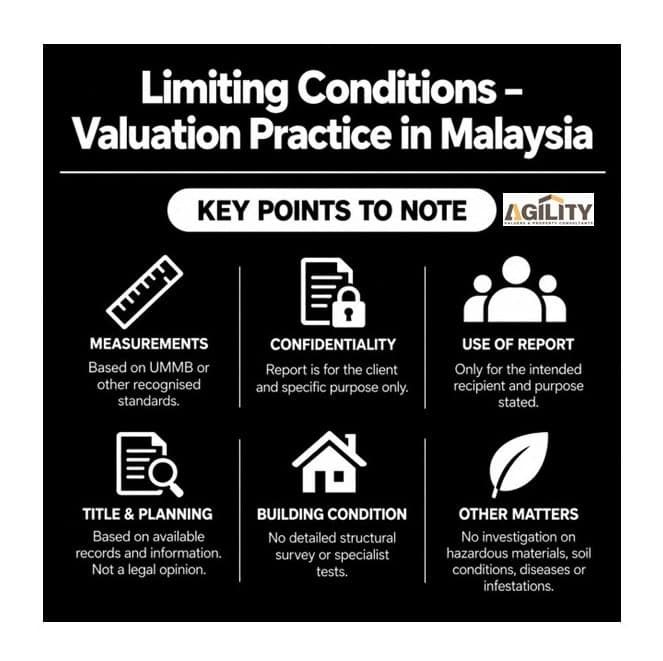
Agility Valuers & Property Consultants would like to highlight some of the Limiting Conditions to which valuation reports prepared by registered valuation firms may be subject.
For the full version of the Limiting Conditions, please refer to Exhibit I of our earlier Insights.:- https://www.agilitymy.com/insight-en/valuation-report-format-and-contents/
Measurements
The measurements of a property are generally based on the Uniform Method of Measurement of Buildings (UMMB) or another measurement standard agreed with the client. For properties outside Malaysia, appropriate local or international measurement standards may also be used.
Example: A condominium is stated in the legal documents to have a built-up area of 2,000 sq ft. The valuer uses the appropriate measurement standard when considering the property’s area for valuation purposes.
Confidentiality
The valuation report is confidential and is prepared for the client and for the specific purpose stated in the report. It should not be given to other parties or published without the valuer’s prior written approval.
Example: A company engages a valuation firm to value its factory for bank financing purposes. The company should not take the valuation report, publish the valuation amount in a newspaper, or use it for another purpose without the valuation firm’s approval.
Use of Report and Valuation
The valuation report should only be used by the intended recipient and for the purpose stated in the report. The valuation firm is not responsible if another person relies on the report or if information from the report is taken out of context.
Example: A client instructs a valuation firm to value a property for accounting purposes. The client cannot automatically use the same valuation report as evidence of the property’s Market Value for a completely different purpose, such as court proceedings in a property dispute.
Title Search
A valuation firm may conduct a title search to obtain information relevant to the valuation, such as the title conditions, land area and registered owner. However, the valuation firm is not a legal professional and does not guarantee that the title is legally valid, accurate or up to date. Legal advice should be obtained if legal confirmation is required.
Example: The title search shows that the land is categorised for commercial use and that the registered owner is ABC Sdn Bhd. The valuation firm may use this information for valuation purposes but does not certify that ABC Sdn Bhd has good and marketable title to the property or that the land is legally approved for commercial use with all relevant conversion premiums fully settled.
Town Planning and Other Statutory Enquiries
Planning information is obtained from available development plans and information provided by the relevant local authority. The valuation firm does not necessarily carry out detailed enquiries with every government authority to determine whether there are future roads, drainage projects or other public schemes that may affect the property.
The valuation firm will also generally assume that the building complies with the relevant statutory requirements. If the Certificate of Fitness for Occupation (CFO) or Certificate of Completion and Compliance (CCC) is not available for inspection, the valuer may assume that it has been duly issued, unless otherwise instructed or informed.
Example: A property may be affected by a future road-widening project that has not been identified during the valuer’s enquiries.
Site Survey
Valuers do not normally carry out a professional land survey to confirm the actual physical boundaries of a property. Instead, they generally assume that the dimensions and boundaries correspond with the title, survey plan or other documents provided.
Example: If the site plan attached to the title shows the land as 50 ft × 100 ft, the valuer may use those dimensions for valuation purposes without independently carrying out a land survey.
Structural Survey and Age of Building
Valuers do not carry out detailed structural surveys or testing of the building and its services and cannot confirm the condition of areas that are hidden, inaccessible or enclosed.
Therefore, the valuation should not be taken as confirmation that the building has no structural problems, termites, rot, pests or other hidden defects.
The stated age of the building may also be an estimate based on available information.
Example: During a site inspection, the valuer notices a small crack on a wall and may mention the crack in the valuation report. However, the valuer cannot determine whether it is merely cosmetic or evidence of a serious structural problem without an appropriate engineering investigation.
Deleterious or Hazardous Materials
Valuers do not normally carry out specialist investigations to determine whether hazardous or harmful materials were used in the construction of a property.
Example: An old building may contain asbestos. Unless a specialist investigation has been carried out, the valuer does not confirm whether asbestos or any other hazardous material is present.
Ground/Soil Investigation
Valuers do not normally conduct soil or ground investigations to determine whether the land is suitable for its current use or proposed future development.
Example: A developer owns vacant land and plans to construct a condominium. The valuer may value the land based on its assumed development potential but does not guarantee that the soil is suitable for construction or that there are no underground conditions requiring expensive foundation works.
Disease or Infestation
Valuers may notice obvious signs of disease or infestation during an inspection but do not normally carry out specialist testing to identify hidden diseases or infestations.
Example: A plantation may appear healthy during the inspection. However, the valuer does not test the crops to determine whether there is a hidden disease that could affect future production.
Personal Property
Unless specifically stated otherwise, movable items and personal property are excluded from the valuation. These may include furniture, loose appliances, collectibles, inventory, supplies and other movable items.
Leases and Tenancies
Valuers do not normally investigate the financial strength of tenants unless specifically instructed to do so.
If the property is valued subject to a tenancy or lease, the valuer may assume that the tenant is able to meet the rental obligations and that there are no undisclosed rental arrears or breaches of the tenancy agreement, unless information to the contrary is provided.
Outstanding Debt
If construction or renovation works have been carried out but the contractor or other professionals have not yet been paid, the valuer does not automatically deduct those outstanding amounts from the valuation.
Example: A building has just been completed and the contractor is still owed RM500,000. Unless otherwise instructed, the valuation is not reduced by RM500,000 simply because the owner has not yet paid the contractor.
Taxation, Encumbrances, Statutory Notices and Outgoings
Unless stated otherwise, the valuation does not automatically deduct disposal costs, taxes arising from a sale, charges or liens, outstanding maintenance fees, service charges and sinking funds, or other outstanding property-related payments.
Example: If there are maintenance fee arrears of RM20,000 and a bank loan outstanding of RM500,000, the valuation does not automatically deduct these amounts from the property’s Market Value.
The valuation is generally provided on the basis that the property is free from encumbrances, unless otherwise stated in the valuation report.
Attendance in Court or at an Inquiry
Preparing a valuation report does not automatically mean that the valuer is required to attend court or appear before a government or statutory authority. If attendance is required, it should be specifically agreed as part of the engagement.
Example: A valuer prepares a valuation report for a property dispute. Later, one party asks the valuer to attend court as an expert witness. If the original valuation instruction did not include court attendance, the valuer is not automatically required to attend court. A separate arrangement may therefore be necessary.
Source of Information
Valuers generally assume that the client has provided all material information that could affect the valuation. If important information has been withheld, the valuer cannot be responsible for the consequences arising from the non-disclosure.
Where information is obtained from the client, an authority or another stated source, the valuer generally relies on that information unless there is a reason to believe that it is unreliable.
Example: The owner tells the valuer that the property is not subject to any tenancy agreement. Later, the valuer discovers that there is actually a long-term tenancy at a below-market rent. If this information was not disclosed to the valuer, the resulting valuation may be affected. The valuer would not normally be responsible for information that was withheld from them.
Proprietary Information
The valuer’s valuation workings, calculations, market intelligence, supporting data and other proprietary information do not automatically have to be provided to the client. The valuer may refuse to release such information where it forms part of the firm’s confidential or proprietary work.
Example: A client asks for a full spreadsheet showing all valuation calculations and every comparable transaction considered by the valuer. The valuer is not automatically required to provide all internal working papers, calculations or proprietary information.
Frequently Asked Questions (FAQs)
Limiting Conditions explain the scope and limitations of the valuer’s work. They clarify what has been considered in the valuation and what has not been investigated.
A valuer is engaged to carry out a specific valuation assignment and is responsible for matters within the agreed scope of work. Limiting Conditions help clarify that the valuer is not responsible for specialist matters outside that scope, such as structural defects, soil conditions or environmental contamination.
No. A valuer’s inspection is not the same as a detailed building or engineering inspection. Hidden structural defects, termites, pests and other specialist matters may require investigation by the appropriate professional.
Generally, a valuation report should only be used for the purpose and by the intended recipient stated in the report. If you wish to use the report for another purpose or allow another party to rely on it, you should first obtain the valuer’s approval.
Not necessarily. The valuer’s internal calculations, working papers and proprietary information are not automatically provided to the client. Similarly, court attendance or attendance at an inquiry should be separately agreed as part of the engagement.
———————————————————————————————————————————————————————
This blog / insight is based on Agility Valuers & Property Consultants / Agility Research (AVPC)’s current understanding and insights about the related topic in the current property / real estate market context. Agility Valuers & Property Consultants / Agility Research (AVPC) makes no guarantees, representation or warranties of any kind, expressed or implied, regarding the information including but not limited to, warranties of content, accuracy and reliability. Interested parties should undertake their own inquiries as to the accuracy of the information. Agility Valuers & Property Consultants Sdn. Bhd. / Agility Research (AVPC) excludes unequivocally all inferred or implied terms, conditions and warranties arising out of this document and excludes all liability for loss or damages arising therefrom.
Neither the whole nor any part of our blog or insights may be included in any published document, circular, prospectus or statement, nor published in any way without the prior written approval of Agility Valuers & Property Consultants Sdn. Bhd. / Agility Research (AVPC). We shall not be obligated to update this blog / insight in response to changes in market conditions or the regulatory environment subsequently.
For more information, please contact:
Sr Yap Kian Ann
Tel: 603-9544 2694 Email: yap@agilitymy.com
HP : 6012-378 5811 Website: www.agilitymy.com
All Rights Reserved
Copyright © 2026 Agility Research
