


Author : Sr Yap Kian Ann,
registered valuer & property consultant
November 6, 2026
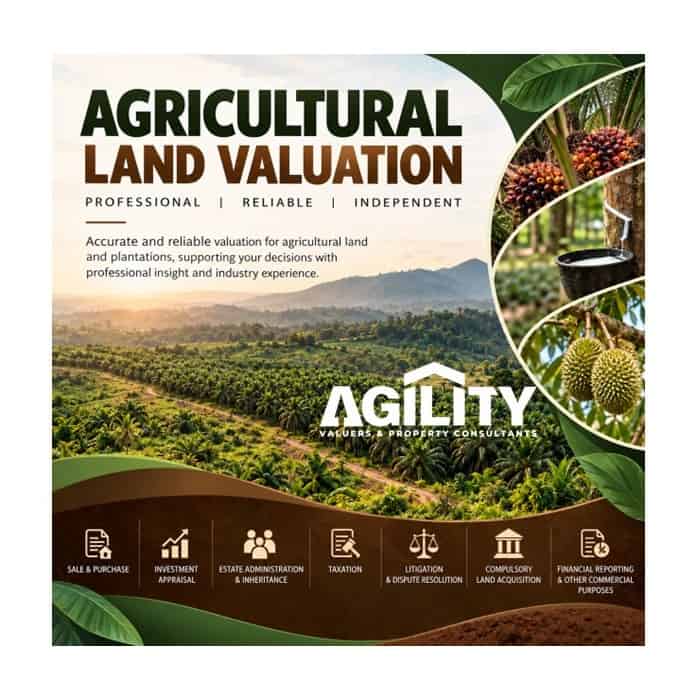
AGRICULTURAL LAND VALUATION
What Is Agricultural Land?
Under Section 52 of the National Land Code 1965, land is categorised into three categories of land use: Agriculture, Building and Industry.
Land under the “Building” category may be designated for residential, commercial, educational, medical, entertainment or other relevant uses, subject to the applicable planning and title Express Conditions. The “Industry” category is generally designated for factories, workshops, warehouses, docks, jetties, railways and other industrial-related uses.
The “Agriculture” category is generally intended for agricultural activities, including the extraction or processing of raw materials from agricultural produce and the distribution of such produce. It may also permit the provision of educational, medical, sanitary and other welfare facilities for persons employed on the land, subject to the applicable legal requirements.
A dwelling house for the owner or persons employed for agricultural purposes may be erected on agricultural land, subject to the relevant statutory requirements and restrictions. In particular, the National Land Code provides for such a dwelling house to occupy no more than one-fifth of the total land area or two hectares, whichever is less.
However, it is important to distinguish between land that is registered under the “Agriculture” category and land that has development potential. Agricultural land may be situated within an area designated for residential, commercial or other non-agricultural uses under the relevant local plan. Such land may be more appropriately described as unconverted development land, where its development potential is supported by the relevant planning provisions and other applicable requirements.
For the purposes of this article, agricultural land refers to land primarily designated for agricultural activities, with no identified development potential for residential, commercial or other non-agricultural uses and which is not situated within an area zoned for non-agricultural purposes under the applicable local plan.
Land Designated for Agricultural Use
The relevant local plans prepared by local planning authorities designate land for various uses, including agriculture, through land-use zoning.
| Local Plan | Agricultural Landuse (%) |
| Majlis Perbandaran Klang 2035 | 5.09 |
| Majlis Perbandaran Bentong 2035 (Bentong) | 23.93 |
| Majlis Perbandaran Bentong 2035 (Sabai) | 17.50 |
| Majlis Perbandaran Bentong 2035 (Pelangai) | 35.25 |
| Malaysia Vision Valley 2045 (Port Dickson District) | 33.69 |
| Majlis Daerah Temerloh 2035 | 44.27 |
| Majlis Perbandaran Kajang 2035 | 12.37 |
| Malaysia Vision Valley 2045 (Seremban District) | 20.99 |
| Majlis Perbandaran Subang Jaya 2035 | 0.00 |
| Majlis Bandaraya Johor Bahru 2035 | 11.26 |
| Majlis Perbandaran Kuala Selangor 2035 | 34.10 |
| Majlis Perbandaran Jasin 2035 | 13.73 |
Agility Valuers & Property Consultants Sdn. Bhd. would like to share selected extracts from local plans to illustrate how agricultural land is designated through land-use zoning.
Scan the QR code below to view extracts from selected local plans showing agricultural land-use zoning.

Why Is Agricultural Land Valuation Important?
Agricultural land valuations are required for a wide range of purposes, including sale and purchase, bank financing and foreclosure, investment appraisal, estate administration and inheritance, taxation, litigation and dispute resolution, financial reporting and accounting, compulsory land acquisition, asset management and portfolio evaluation, statutory requirements and other commercial purposes.
What Determines the Value of Agricultural Land?
As with other types of property, agricultural land has its own set of characteristics that may affect its market value. These factors include, but are not limited to, the following:
Location – The property’s geographical location, surrounding environment, proximity to towns and markets, and accessibility to agricultural support services can influence its value.
Land Size and Shape – The total land area and its configuration affect the efficiency of land utilisation and the practicality of farming operations.
Tenure and Title Conditions – The type of tenure, remaining lease period, land-use category, express conditions and restrictions in interest may affect the property’s marketability and value.
Accessibility – The availability and condition of access roads influence the time and cost required to transport agricultural produce, move machinery and carry out farming operations.
Topography – The land’s elevation, gradient and surface characteristics affect its suitability for cultivation, drainage requirements, erosion risks and land preparation costs.
Soil and Agricultural Productivity – Soil type, fertility, depth and suitability for particular crops influence agricultural productivity and the land’s income-generating potential.
Existing Crops and Improvements – The type, age, condition and maturity of existing crops, together with improvements such as farm buildings, irrigation systems, fencing and internal roads, contribute to the property’s overall value. Land planted with commercially valuable crops may command a higher market value, depending on the crops’ productivity, remaining economic life and prevailing market conditions.
Water Supply and Drainage – The availability and reliability of water sources, irrigation facilities and effective drainage systems are important for supporting crop growth, maintaining productivity and minimising the risks of flooding and waterlogging.
Method of Valuation
The Comparison Method is commonly used to assess the market value of agricultural land. Under this method, the value of the subject property is determined by comparing it with similar properties that have been sold recently or are currently being offered for sale in the vicinity. Appropriate adjustments are made to reflect differences between the comparable properties and the subject property, including differences in location, tenure, land size, accessibility, topography and other relevant characteristics.
The resulting adjusted rates are then analysed to arrive at an appropriate market value for the subject property, taking into account the nature and extent of any existing improvements.
For commercial agricultural plantations, the Discounted Cash Flow (DCF) approach may also be adopted, where appropriate.
Under the DCF approach, the value of the subject property is estimated based on the present value of the anticipated future cash flows generated over the economic life of the crops. The projected gross income is estimated based on factors such as crop yields, production volumes and prevailing or forecast selling prices.
The associated operating expenses, including cultivation and maintenance costs, general estate expenses and harvesting and collection costs, are then deducted from the projected income to derive the net cash flow. These projected net cash flows are discounted to their present value using an appropriate discount rate, and their aggregate present value forms the basis of the valuation.
Where the valuation concerns an operating plantation, the estate may be assessed as a going concern, taking into account the land, crops, buildings, infrastructure, machinery, equipment, motor vehicles and other relevant assets necessary for its operation. The valuation approach and the assets included in the assessment will depend on the scope of the valuation and the basis of value adopted.
What Improvements on the Land Does a Registered Valuer Consider?
In addition to the bare land value, a registered valuer will consider relevant improvements when assessing the market value of an agricultural property.
These improvements may include existing crops planted on the land, such as oil palms, durian trees, rubber trees and other fruit trees that produce commercially valuable agricultural products.
Other improvements may include buildings used for storing agricultural produce, fertilisers and pesticides, as well as workers’ accommodation. Additional site improvements, such as estate roads, irrigation systems, fencing, electricity infrastructure and water supply facilities, may also contribute to the property’s overall value.
The contribution of these improvements will depend on their condition, utility, remaining economic life, productivity and relevance to the property’s intended use.
How Should Comparable Sales Be Selected?
Under the Comparison Method of Valuation, the registered valuer analyses available transaction data and selects comparable properties considered relevant and suitable for assessing the market value of the subject property.
Various factors are considered when selecting and analysing comparable transactions, including the transaction date, location and proximity to the subject property, type of planting, land size, tenure, accessibility, topography, plot shape and other relevant characteristics.
Appropriate adjustments are then made to account for differences between the comparable properties and the subject property.
The comparable transactions are evaluated based on their relevance and reliability rather than merely ranked. One or two transactions may be identified as the most representative comparables, with their analysed rates adopted, together with appropriate adjustments and professional judgement, in determining the market value of the subject property. Other relevant comparables may also be included in the valuation report for reference and information purposes.
What Documents Are Required for Agricultural Land Valuation?
The documents and information generally required to undertake an agricultural land or plantation valuation include the following:
Additional documents or information may be requested depending on the type of agricultural property, the scope of the valuation and the purpose for which the valuation is required.
For further insights into a sample valuation report for agricultural land, please refer to our article :
https://www.agilitymy.com/insight-en/valuation-report-oil-palm-estate-a-case-study/
Please contact our property consultants for further clarification or to discuss your property valuation requirements. We are ready to assist you with our professional valuation services.
Contact: A-5-6, Level 6, Block A, Jaya One, No. 72A, Jalan Profesor Diraja Ungku Aziz, Seksyen 13, 46200 Petaling Jaya, Selangor. Tel : +603 – 9544 2694 | WhatsApp : +6012 – 733 5356 Email : agility@agilitymy.com Website : www.agilitymy.com
Frequently Asked Questions (FAQs)
Agricultural land valuation is the process of estimating the market value of land used for agricultural purposes, taking into account factors such as location, land size, tenure, soil conditions, existing crops and agricultural improvements.
The value of agricultural land is influenced by its location, land size, accessibility, tenure, title conditions, topography, soil quality, water supply, existing crops and improvements.
The Comparison Method is commonly used to assess the market value of agricultural land by analysing comparable property transactions. For commercial agricultural plantations, the Discounted Cash Flow (DCF) approach may also be adopted, where appropriate.
Commonly required documents include the land title, site plan, estate map, hectarage statement, crop age and yield records, estate performance indicators, and details of machinery and equipment. Tenancy or lease information may also be required, where applicable.
An agricultural land valuation may be required for sale and purchase, bank financing, investment appraisal, inheritance and estate administration, taxation, financial reporting, compulsory land acquisition, litigation and other commercial purposes.
———————————————————————————————————————————————————————
This blog / insight is based on Agility Valuers & Property Consultants / Agility Research (AVPC)’s current understanding and insights about the related topic in the current property / real estate market context. Agility Valuers & Property Consultants / Agility Research (AVPC) makes no guarantees, representation or warranties of any kind, expressed or implied, regarding the information including but not limited to, warranties of content, accuracy and reliability. Interested parties should undertake their own inquiries as to the accuracy of the information. Agility Valuers & Property Consultants Sdn. Bhd. / Agility Research (AVPC) excludes unequivocally all inferred or implied terms, conditions and warranties arising out of this document and excludes all liability for loss or damages arising therefrom.
Neither the whole nor any part of our blog or insights may be included in any published document, circular, prospectus or statement, nor published in any way without the prior written approval of Agility Valuers & Property Consultants Sdn. Bhd. / Agility Research (AVPC). We shall not be obligated to update this blog / insight in response to changes in market conditions or the regulatory environment subsequently.
For more information, please contact:
Sr Yap Kian Ann
Tel: 603-9544 2694 Email: yap@agilitymy.com
HP : 6012-378 5811 Website: www.agilitymy.com
All Rights Reserved
Copyright © 2026 Agility Research
