


Author : Sr Yap Kian Ann,
registered valuer & property consultants
August 26, 2026
What is a Shopping Complex?
In accordance with the NAPIC Property Market Report, a shopping complex is defined as a multi-unit retail establishments under a covered walkway that encourages pedestrian flow to sustain business activity. Shopping complexes disseminated by NAPIC include shopping centres, shopping arcades and stand-alone hypermarkets.
To ordinary consumers, shopping complexes are much more than places to shop. They provide a wide range of everyday needs and services, including grocery shopping, food and beverage, banking, salons, basic medical services, fitness, education and entertainment. Increasingly, shopping complexes also serve as places for social interaction, leisure and family activities.
For those living in urban areas, particularly in places such as Kuala Lumpur and Petaling Jaya, it may sometimes feel as though there are simply too many shopping complexes. It is not unusual to find several shopping destinations within a 5-kilometre radius.
Do We Have Too Many Shopping Complexes?
So, does Malaysia have too many shopping complexes?
Whenever a new shopping complex is proposed or nearing completion, it is common to hear comments that Malaysia already has too many shopping centres. Yet developers continue to introduce new projects.
While the supply of shopping space may not always be evenly distributed, developers generally undertake market and feasibility studies before committing to a project. Ultimately, they bear the development costs and are responsible for the profitability of their developments. If a particular market is genuinely saturated and the project is unlikely to be viable, there would be little commercial justification for adding further supply.
The performance of existing shopping complexes also provides an important indication of market conditions. Many Bursa Malaysia-listed retail REITs have continued to record resilient revenue performance and asset revaluations, although there are also shopping complexes that have not performed up to expectations.
Against this background, Agility Valuers & Property Consultants Sdn. Bhd. would like to share our compilation and analysis of Shopping Complex Net Lettable Area (SCNLA) per capita to provide a broader perspective on the amount of shopping space available in Malaysia relative to its population.
What is Shopping Complex NLA per Capita?
Shopping Complex NLA (SCNLA) per capita refers to the amount of net lettable area (NLA) of shopping complexes available for each person within a defined market or geographical area.
Formula:
Shopping Complex NLA per Capita = Total Shopping Complex NLA ÷ Population
Our survey indicates that SCNLA per capita across various countries generally ranges from the low single digits to around 20 square feet per capita.
Where does Malaysia stand?
Malaysia records an SCNLA per capita of approximately 5.43 square feet, placing it within the moderate range. In simple terms, this means that there is approximately 5.43 square feet of shopping complex NLA for every Malaysian.
The following tables and charts illustrate the shopping complex stock and SCNLA per capita by state.
Net Lettable Area of Shopping Complexes by State
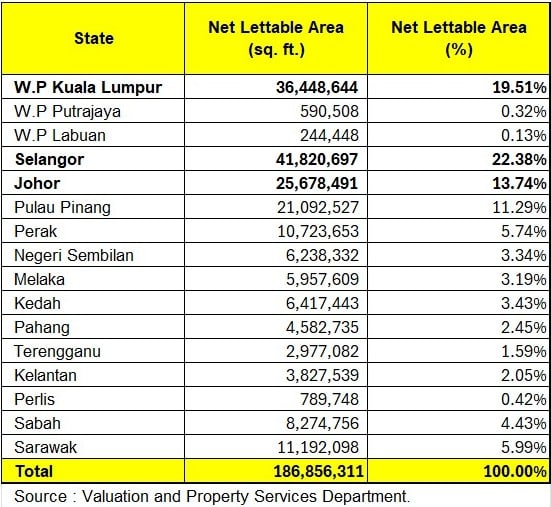
Selangor, with approximately 41.8 million square feet, has the largest shopping complex stock, followed by Kuala Lumpur at 36.4 million square feet and Johor at 25.7 million square feet.
When measured against population, however, the picture is somewhat different. Kuala Lumpur, Pulau Pinang and Johor recorded the three highest SCNLA per capita figures at approximately 17.50, 11.66 and 6.08 square feet per capita, respectively.
Net Lettable Area of Shopping Complexes per Capita
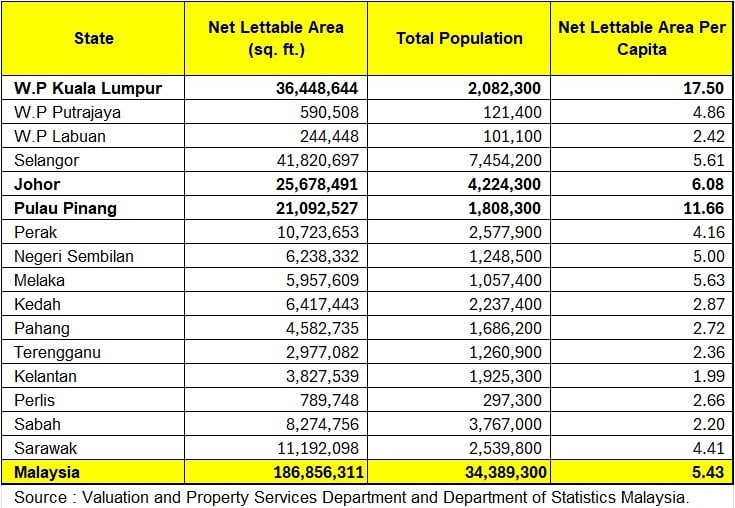
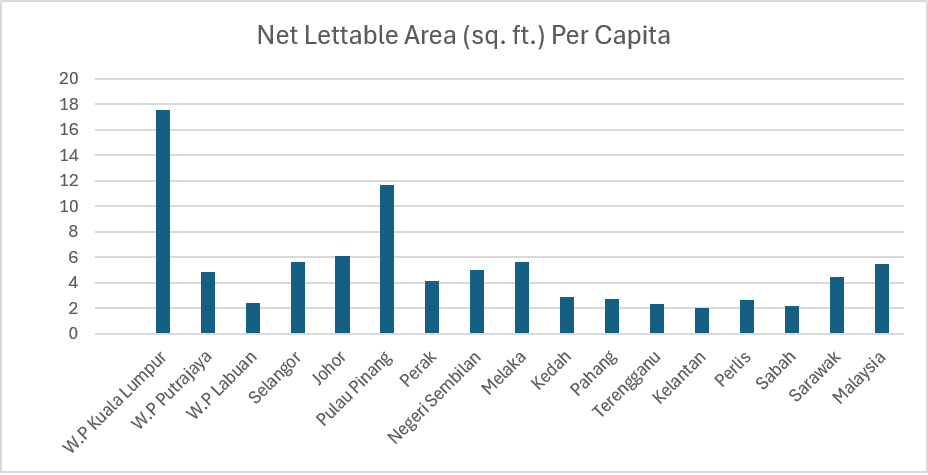
It is important to note that SCNLA per capita does not represent the direct demand for shopping space from the resident population. Shopping complexes do not serve only the people who live within their immediate geographical boundaries. They also attract workers and students from other areas, domestic and international tourists, commuters, and visitors travelling to major commercial areas and transport hubs.
For example, many shopping complexes in Kuala Lumpur serve a much wider catchment that extends beyond the city itself, including residents from Selangor and visitors from other states and countries.
Occupancy of Shopping Complexes
If the question is whether Malaysia has too much shopping space, occupancy provides another useful indicator.
The overall occupancy of shopping complexes in Malaysia was approximately 79%, while Kuala Lumpur recorded a higher occupancy of about 88%.
Occupancy of Shopping Complexes by State
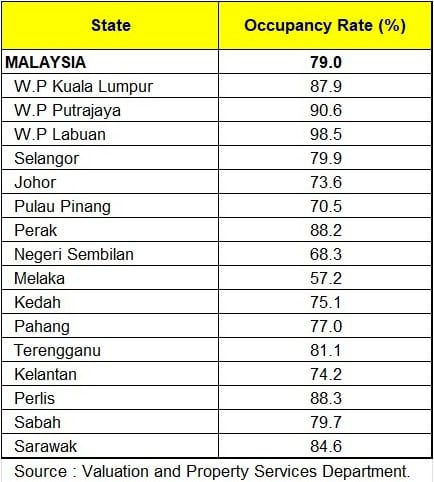
The occupancy figures suggest that the Malaysian shopping complex market is not uniformly oversupplied. While some individual centres may face challenges in attracting and retaining tenants, other well-located and well-managed shopping complexes continue to achieve relatively strong occupancy.
Therefore, SCNLA per capita should be viewed as an indicator of supply rather than a direct measure of oversupply. The performance of a shopping complex depends on many other factors, including its location, catchment population, accessibility, tenant mix, positioning, competition, quality and consumer spending patterns.
Shopping Complexes in Klang Valley
More than 40% of Malaysia’s shopping complex stock, measured by NLA, is located within the Klang Valley. This concentration of retail supply helps explain why residents of Kuala Lumpur and surrounding areas may have the perception that shopping complexes are everywhere.
With numerous shopping destinations within a relatively small geographical area, consumers have a wide range of choices and can select shopping centres according to their preferred location, tenant mix, dining options, entertainment offerings and overall experience.
Agility Valuers & Property Consultants Sdn. Bhd. would like to highlight selected shopping complexes in the Klang Valley, together with their respective NLA and occupancy rates, to provide a closer look at the competitive retail landscape.
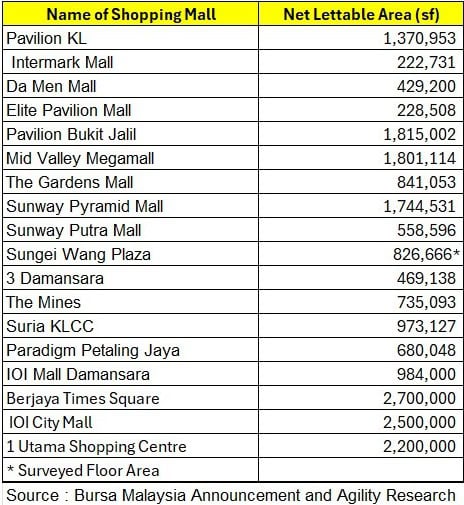
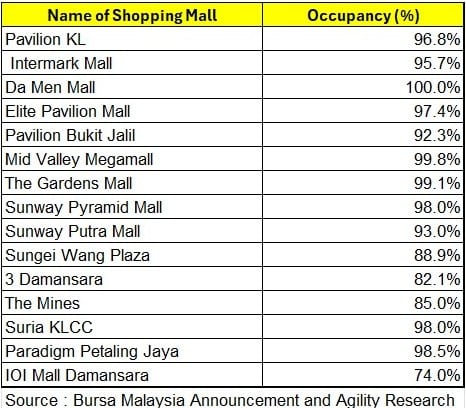
The Klang Valley also has approximately 10 “megamalls”, each with around 1 million square feet or more of NLA. These large-scale shopping complexes offer consumers a comprehensive, one-stop shopping, dining, leisure and entertainment experience and have become major retail destinations in their respective catchment areas.
Conclusion
So, does Malaysia have too many shopping complexes?
The answer cannot be determined simply by looking at the number of shopping complex or the SCNLA per capita. Malaysia’s 5.43 square feet of SCNLA per capita indicates a moderate level of shopping space nationally, while the relatively healthy occupancy levels suggest that the market as a whole is not necessarily experiencing widespread oversupply.
However, the national average can mask significant differences between individual markets. The concentration of more than 40% of shopping complex NLA in the Klang Valley means that some urban markets are considerably more competitive than others.
Ultimately, the more relevant question is not “Do we have too many shopping complexes?”, but “Do we have the right and well-managed shopping complexes, in the right locations, serving the right catchments?”
As the retail landscape continues to evolve, location, catchment, accessibility, tenant mix, experience and effective management will matter more than simply the amount of shopping space available. A market may have a large amount of NLA, yet well-positioned and relevant shopping complexes can continue to perform strongly.
In short, Malaysia may not have too much shopping space overall, but some locations may have too much of the wrong type of shopping space.
Frequently Asked Questions
Shopping Complex NLA (SCNLA) per capita measures the amount of net lettable area (NLA) of shopping complexes available for each person within a particular market or geographical area.
The formula is:
SCNLA per Capita = Total Shopping Complex NLA ÷ Population
It is primarily a measure of shopping space supply relative to population, rather than a direct measure of retail demand.
Not necessarily. Malaysia records approximately 5.43 square feet of shopping complex NLA per capita, which is considered a moderate level compared with the range observed across various markets.
The overall occupancy of shopping complexes, at approximately 79% nationally, also suggests that Malaysia is not experiencing widespread oversupply. However, supply and performance can vary significantly between locations.
Kuala Lumpur, Pulau Pinang and Johor recorded the highest SCNLA per capita, at approximately 17.50, 11.66 and 6.08 square feet per capita, respectively.
This does not necessarily mean these states have excessive shopping space. Their higher ratios may also reflect tourism, workers, students, commuters and visitors from outside the resident population who contribute to the catchment and demand of their shopping complexes.
No. SCNLA per capita is an indicator of supply relative to population, not a direct measure of oversupply.
A shopping complex may have a high NLA per capita but still perform well if it has a strong catchment, good accessibility, attractive tenant mix, effective management and strong consumer spending. Conversely, a market with a lower NLA per capita may still have underperforming shopping complexes if the existing supply is poorly located or incorrectly positioned.
Therefore, SCNLA per capita should be considered together with occupancy, rental performance, catchment population, competition, accessibility, consumer spending and the quality and positioning of the shopping complex.
More than 40% of Malaysia’s shopping complex stock, measured by NLA, is concentrated in the Klang Valley. Kuala Lumpur also records a particularly high SCNLA per capita of approximately 17.50 square feet.
The concentration of supply within a relatively compact and highly urbanised area means that residents can often access several shopping destinations within a short distance. In addition, Klang Valley shopping complexes serve a much wider catchment than their immediate residential population, including workers, students, commuters, tourists and visitors from other states.
Therefore, the perception that there are “too many” shopping complexes may be particularly strong in the Klang Valley, even though the national SCNLA per capita remains at a moderate level.
———————————————————————————————————————————————————————
This blog / insight is based on Agility Valuers & Property Consultants / Agility Research (AVPC)’s current understanding and insights about the related topic in the current property / real estate market context. Agility Valuers & Property Consultants / Agility Research (AVPC) makes no guarantees, representation or warranties of any kind, expressed or implied, regarding the information including but not limited to, warranties of content, accuracy and reliability. Interested parties should undertake their own inquiries as to the accuracy of the information. Agility Valuers & Property Consultants Sdn. Bhd. / Agility Research (AVPC) excludes unequivocally all inferred or implied terms, conditions and warranties arising out of this document and excludes all liability for loss or damages arising therefrom.
Neither the whole nor any part of our blog or insights may be included in any published document, circular, prospectus or statement, nor published in any way without the prior written approval of Agility Valuers & Property Consultants Sdn. Bhd. / Agility Research (AVPC). We shall not be obligated to update this blog / insight in response to changes in market conditions or the regulatory environment subsequently.
For more information, please contact:
Sr Yap Kian Ann
Tel: 603-9544 2694 Email: yap@agilitymy.com
HP : 6012-378 5811 Website: www.agilitymy.com
All Rights Reserved
Copyright © 2026 Agility Research
