


Author : Sr Yap Kian Ann,
registered valuer & property consultants
August 8, 2026
If you have obtained a property valuation, particularly for financing purposes, you may have noticed that your valuer provides both Market Value (MV) and Forced Sale Value (FSV) in the valuation report.
What is the difference between these two values, and why are both important?
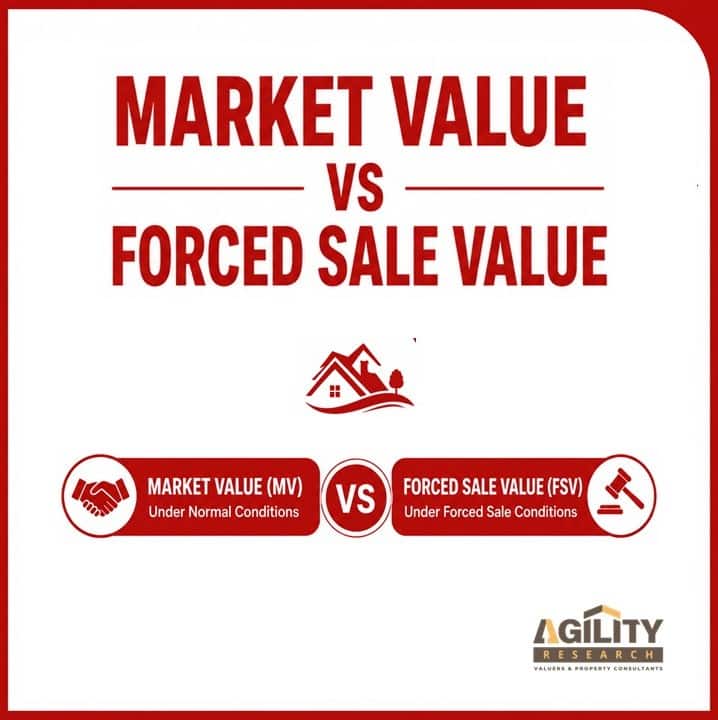
In simple terms, Market Value represents the price that a property could reasonably achieve if it were properly exposed to the open market under normal selling conditions. It assumes a willing and knowledgeable buyer and seller, proper marketing, sufficient marketing time, and no compulsion on either party.
Forced Sale Value, on the other hand, represents the price that may reasonably be achieved when the property has to be sold under circumstances that do not satisfy all the conditions of a normal market transaction. This may involve an unwilling seller, a limited marketing period, financial pressure, or other circumstances that require the property to be disposed of within a shorter period.
Agility Valuers & Property Consultants Sdn. Bhd. would like to explain the key elements of Market Value and Forced Sale Value in simple terms by looking at their respective definitions.
What is Market Value?
Market Value (MV) is the estimated amount for which an asset or liability would be exchanged on the valuation date between a willing buyer and a willing seller in an arm’s-length transaction, after proper marketing, where both parties have acted knowledgeably, prudently and without compulsion.
In simple terms, Market Value is the most reasonable price that a property could be expected to achieve in the open market under normal selling conditions.
“The estimated amount”
“The estimated amount” means that Market Value is an estimated price expressed in monetary terms, rather than a guaranteed selling price.
It represents the price that could reasonably be expected to be achieved in a normal arm’s-length transaction on the valuation date. It is intended to reflect the best price reasonably obtainable by the seller and the most reasonable price that a buyer would be expected to pay.
The estimate does not take into account special terms, unusual arrangements or special circumstances that could cause the transaction price to be different from normal market conditions.
For example, a seller should not claim a higher Market Value simply because a buyer agrees to purchase the property at a high price on the condition that the seller leases the property back at a rental significantly above the prevailing market rental. Such special arrangements may result in a price that does not represent normal Market Value.
Therefore, Market Value is not necessarily the highest price that a particular buyer may be willing to pay under special circumstances.
“An asset or liability should exchange”
This means that Market Value is an estimated amount, rather than a fixed price or the actual price achieved in a particular transaction.
In other words, the Market Value stated by a valuer represents the price that the property could reasonably be expected to achieve if all the conditions of the Market Value definition were satisfied on the valuation date.
Therefore, Market Value is a likely or reasonably achievable amount, and not a guarantee that the property will actually be sold at that price.
“On the valuation date”
Market Value is always specific to a particular date.
Property markets and economic conditions can change over time. Interest rates, supply and demand, buyer sentiment, economic conditions and other market factors may cause property values to increase or decrease.
Therefore, a Market Value determined as at 8 August 2026, for example, reflects the market conditions and circumstances prevailing on that particular date. It does not necessarily represent the value of the property at a later date.
In practice, the date of valuation is often the date of inspection, unless otherwise specified or instructed.
“Between a willing buyer”
A “willing buyer” refers to a buyer who is motivated to purchase but is not forced or compelled to do so.
The buyer is not assumed to be overly eager or prepared to pay any price simply to secure the property. Instead, the buyer is expected to consider the prevailing market conditions and make a reasonable purchasing decision based on the information available at the valuation date.
For example, a contractor who is required to purchase a particular property from a developer in order to offset or contra a construction contract sum may not represent a typical willing buyer, because the purchase is influenced by circumstances outside a normal property investment or acquisition decision.
The hypothetical willing buyer would therefore purchase the property based on its market characteristics and prevailing market conditions, rather than because of a special obligation or compulsion.
“And a willing seller”
A “willing seller” refers to a seller who is motivated to sell but is not forced or compelled to do so.
The seller is prepared to offer the property to the open market and seek the best price reasonably obtainable under normal market conditions. However, the seller is not assumed to insist on an unreasonable price or to hold on to the property indefinitely in the hope of obtaining an unrealistic price.
The personal circumstances of the actual owner are generally not considered because the willing seller is a hypothetical seller.
For example, a property owner who voluntarily decides to sell the property in the open market would generally represent a willing seller. This is different from a situation where the property is being sold because of a loan default and is subject to foreclosure or other enforcement proceedings.
“In an arm’s-length transaction”
An arm’s-length transaction is a transaction between independent parties who do not have a special relationship that could influence the price.
For example, a related-party transaction (RPT), such as a shareholder selling a property to a company controlled by that shareholder, may result in a price that is different from normal market conditions.
Similarly, a transaction between a landlord and tenant may involve circumstances that could influence the agreed price.
For Market Value purposes, the transaction is assumed to take place between independent parties, with each party acting in its own best interest.
“After proper marketing”
“After proper marketing” means that the property has been properly exposed to the market using an appropriate method of sale and for a sufficient period of time to provide a reasonable opportunity to achieve the best price obtainable.
There is no fixed marketing period applicable to every property. The appropriate period will depend on factors such as the type of property, location, market conditions, building condition, demand and the number of potential buyers.
The important consideration is that the property should have sufficient exposure to enable an adequate number of potential buyers to become aware of the opportunity.
For example, the owner may engage a registered estate agency firm to market the property through appropriate advertising channels and introduce the property to potential purchasers. This provides the property with reasonable market exposure before a sale is concluded.
The marketing and exposure period occurs before the valuation date.
“Where the parties had each acted knowledgeably and prudently”
This means that both the buyer and seller are assumed to have reasonable knowledge of the property and the prevailing market conditions.
They are assumed to understand relevant matters such as the property’s characteristics, location, condition, actual and potential uses, and prevailing market prices.
Both parties are also assumed to use this information carefully when negotiating the transaction.
For example, a buyer may obtain advice from a registered valuer, property consultant, lawyer or other relevant professional before deciding on an appropriate price.
Prudence is assessed based on the information available on the valuation date, rather than information that becomes available later.
For example, if the property market is declining, a seller who accepts a lower price based on the prevailing market conditions is not necessarily acting imprudently. The seller is expected to make a reasonable decision based on the best information available at that time.
“And without compulsion”
This means that neither the buyer nor the seller is forced, pressured or unduly influenced to complete the transaction.
Both parties are willing to enter into the transaction and have the freedom to decide whether or not to proceed.
For example, a normal open-market sale would generally involve a seller who voluntarily decides to sell and a buyer who voluntarily decides to purchase.
This is different from circumstances such as a bank foreclosure, distress sale or other compulsory disposal, where the seller may have limited control over the timing and circumstances of the sale.
What is the Forced Sale Value?
Forced Sale Value (FSV) is the estimated amount that may reasonably be obtained from the sale of a property when the property has to be disposed of under circumstances that do not meet all the conditions of a normal Market Value transaction.
Unlike Market Value, a forced sale may involve a shorter marketing period, limited publicity, reduced opportunity for negotiation, an unwilling seller, financial pressure or other circumstances that require the property to be sold quickly.
For example, a property owner facing serious financial difficulties may need to sell the property within two weeks to raise funds. The owner may not have sufficient time to properly market the property, identify a wide range of potential buyers and negotiate for the best possible price. In such circumstances, the buyer may be required to purchase the property on a cash basis, without relying on bank financing. It should also be noted that the pool of cash buyers may be limited, which could further affect the marketability and achievable selling price of the property. In such circumstances, the price achieved may be lower than Market Value.
Why can Forced Sale Value be lower than Market Value?
Market Value assumes that the property has been properly marketed and that the seller has sufficient time to find a suitable buyer.
A forced sale is different because the seller may have limited time and bargaining power.
Potential buyers may also be aware that the seller needs to sell quickly. As a result, they may make offers below what they would normally offer if the seller had sufficient time and flexibility to negotiate.
Therefore, the Forced Sale Value may be lower than the Market Value.
What is meant by “Forced Sale”?
A forced sale refers to a disposal where the seller is unwilling or has limited freedom to decide when and how the property is sold.
This situation may arise from circumstances such as:
Financial difficulties;
Loan default;
Bankruptcy;
Court proceedings;
Liquidation;
Foreclosure;
Public auction; or
Other circumstances requiring the property to be sold within a limited period.
In these situations, the seller may have limited bargaining power and may not be able to wait for the best possible offer.
It is important to understand that a forced sale does not necessarily mean that the property itself is distressed or defective.
The property may be in perfectly normal physical condition. The term “forced sale” mainly relates to the circumstances surrounding the sale, particularly the seller’s lack of time or freedom to conduct a normal marketing exercise.
Basis for the Forced Sale Value
The Forced Sale Value adopted in a valuation is generally based on the assumption that the property is required to be disposed of under circumstances involving an unwilling seller who is subject to compulsion or duress.
It also assumes that the property does not have the same adequate marketing period and exposure that would normally be available for achieving Market Value.
The valuer may therefore consider factors such as:
Type and location of the property;
Prevailing market conditions;
Demand for the property;
Availability of potential purchasers;
Expected marketing period;
Saleability of the property;
Remaining tenure (very short unexpired term), where relevant; and
Other factors that may affect the price achievable under forced-sale circumstances.
Forced Sale Value is not Market Value
It is important to understand that Forced Sale Value should not be regarded as the Market Value of the property.
Market Value represents what the property could reasonably achieve under normal market conditions, while Forced Sale Value represents what may reasonably be achieved under the specific forced-sale circumstances assumed for the valuation.
The actual price eventually achieved in a forced sale may be higher or lower than the valuer’s estimated Forced Sale Value, depending on the circumstances and market response at the time of disposal.
Why do financial institutions require Forced Sale Value?
Financial institutions may request Forced Sale Value as an additional reference when assessing the security value and financing risk of a property.
This is particularly relevant because, if a borrower defaults on a loan, the financial institution may eventually need to dispose of the property, including through foreclosure or public auction, to recover the outstanding loan amount.
The FSV therefore provides an indication of the potential realizable value of the property under less favourable disposal circumstances.
How is Forced Sale Value determined?
There is no single fixed percentage that applies to all properties.
In practice, the FSV may often be assessed at a percentage below Market Value, with the appropriate level depending on the type, location and characteristics of the property and the circumstances of the potential forced disposal.
As a general market practice, FSV may sometimes fall within the range of approximately 70% to 80% of Market Value, although this should not be treated as a standard or automatic rule.
For certain assets, such as plant and machinery, the FSV may be lower, potentially in the range of approximately 50% to 60% of Market Value, depending on the asset and its marketability.
The appropriate FSV should be determined based on the specific circumstances and saleability of the property rather than simply applying a fixed percentage. Factors such as location, property type, tenure, remaining lease term, market demand and the likely method of disposal may all affect the achievable price.
In many auction situations, properties may need to be offered at an attractive price below Market Value in order to generate sufficient interest from potential bidders.
Not every Forced Sale is a bank auction
It is also important to note that not every transaction below Market Value is a bank auction or formal foreclosure sale.
From time to time, properties may be offered at attractive prices in the open market because the owners are facing financial difficulties, urgent funding requirements, partnership disputes, relocation, or other personal or business circumstances that require them to sell quickly.
Such properties may present themselves as “good buys” in the market because the seller is prepared to accept a lower price in exchange for a faster disposal.
However, the circumstances of each transaction should be carefully considered before concluding whether the transaction is representative of Market Value or a forced-sale situation.
Conclusion
In summary, Market Value and Forced Sale Value serve different purposes.
Market Value reflects the price that a property could reasonably achieve under normal market conditions, assuming proper marketing, sufficient exposure, willing and knowledgeable parties, an arm’s-length transaction and no compulsion.
Forced Sale Value reflects the estimated price that may reasonably be achieved where the property has to be sold under less favourable circumstances, such as a shortened marketing period, limited exposure, financial pressure or other circumstances affecting the seller’s ability to negotiate freely.
Understanding the distinction between these two values is particularly important for property owners, purchasers, investors and financial institutions when assessing the realistic value and risk associated with a property.
Please feel free to contact Agility Valuers & Property Consultants Sdn. Bhd. should you require further clarification or professional assistance regarding property valuation matters.
For more articles and property valuation insights, please visit the Agility Valuers & Property Consultants Sdn. Bhd. Insights section of our website (link to https://www.agilitymy.com/insights/)
Frequently Asked Questions (FAQs)
Market Value is the estimated price a property could reasonably achieve under normal market conditions, with proper marketing and sufficient time for sale. Forced Sale Value reflects the estimated price that may be achieved when the property has to be sold under less favourable circumstances, such as limited marketing time or financial pressure.
Forced Sale Value may be lower because the seller may have limited time and bargaining power. Potential buyers may also offer a lower price because they know the seller needs to complete the sale quickly.
Not necessarily. Forced Sale Value is an estimated value under forced-sale circumstances. A bank auction is one example of a forced-sale situation, but a property may also be sold under other circumstances involving financial pressure or an urgent need for disposal.
There is no single fixed percentage applicable to every property. The valuer considers factors such as the property’s type, location, market conditions, demand, saleability, marketing period and other circumstances that may affect the price achievable under a forced sale.
Financial institutions may use Forced Sale Value as an additional reference when assessing the property’s security value and financing risk. It provides an indication of the potential amount that may be recoverable if the property needs to be disposed of under less favourable circumstances, such as foreclosure or public auction.
———————————————————————————————————————————————————————
This blog / insight is based on Agility Valuers & Property Consultants / Agility Research (AVPC)’s current understanding and insights about the related topic in the current property / real estate market context. Agility Valuers & Property Consultants / Agility Research (AVPC) makes no guarantees, representation or warranties of any kind, expressed or implied, regarding the information including but not limited to, warranties of content, accuracy and reliability. Interested parties should undertake their own inquiries as to the accuracy of the information. Agility Valuers & Property Consultants Sdn. Bhd. / Agility Research (AVPC) excludes unequivocally all inferred or implied terms, conditions and warranties arising out of this document and excludes all liability for loss or damages arising therefrom.
Neither the whole nor any part of our blog or insights may be included in any published document, circular, prospectus or statement, nor published in any way without the prior written approval of Agility Valuers & Property Consultants Sdn. Bhd. / Agility Research (AVPC). We shall not be obligated to update this blog / insight in response to changes in market conditions or the regulatory environment subsequently.
For more information, please contact:
Sr Yap Kian Ann
Tel: 603-9544 2694 Email: yap@agilitymy.com
HP : 6012-378 5811 Website: www.agilitymy.com
All Rights Reserved
Copyright © 2026 Agility Research
